

Agentforce now bills four different ways depending on where you deploy it. Here is how to build a number your CFO will actually sign.
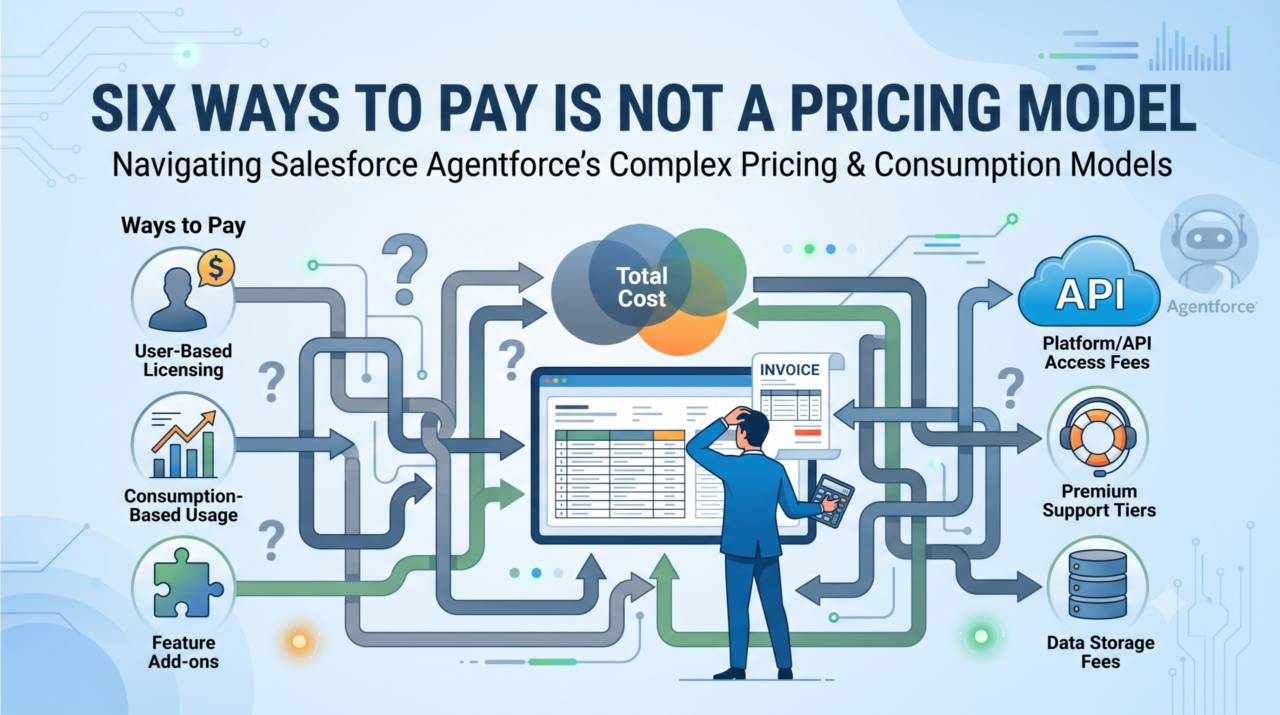
Somebody in your organization is going to ask what Agentforce costs. They will expect a number. What they will get, if they go looking on their own, is a pricing page with a free tier, a per-action model, a per-conversation model, a per-resolution model, two per-user add-on tiers, a $550 edition, a $5 user license, and three separate buying structures layered on top of all of it.
Every one of those is real. Several of them are mutually exclusive. One of them cannot be combined with another in the same org. And the answer to “what will this cost us” depends less on the rate card than on a variable most teams have never measured: how many actions your workflow actually takes.
This is not a complaint about Salesforce charging money for software. It is an argument that Agentforce cost is an architecture output, not a procurement input, and that treating it otherwise is how orgs end up explaining variance instead of forecasting it.
Here is the actual structure, the math that decides which model wins, and the estimate method that survives contact with finance.
The models, stated plainly
Salesforce Foundations. $0. Available to Enterprise Edition and above. Includes 200,000 Flex Credits, 250,000 Data Cloud credits, Agent Builder, and Prompt Builder. This is not a trial. It is a permanent tier, and it is the correct place to start any evaluation before a single commercial conversation happens.
Flex Credits. $500 per 100,000 credits. Consumption by action. A standard Agentforce action costs 20 credits, roughly $0.10. A Voice action costs 30 credits, roughly $0.15. Credits draw from a shared pool across teams, channels, and use cases. This is the model that covers customer-facing agents, employee-facing agents, Voice, Digital Wallet, and Agentforce Vibes.
Conversations. $2 per conversation. A fixed rate per interaction rather than per action. Customer-facing agents and Digital Wallet. This was the original headline model.
Pay-per-resolution. $2, or 400 Flex Credits, per resolved inquiry. Introduced in June 2026 for the Agentforce Help Agent. Outcome-based rather than activity-based. More on this one below, because the definition matters enormously.
Per-user add-ons. $125 per user per month for Sales, Service, and Field Service; $150 for Industries Clouds. Unmetered Agentforce usage for employees, full AI suite, Prompt Builder.
Agentforce 1 Editions. From $550 per user per month. Includes the add-ons plus 2.5M Flex Credits per org per year. And separately, the Agentforce User License at $5 per user per month, which deploys agents company-wide but still requires Flex Credits underneath.
Then the buying structures: Pre-purchase (buy usage upfront for the contract term, best rate), Pre-Commit (commit to a baseline, no upfront payment, billed monthly, trued up at term end, widely available later this year), and PayGo (no commitment, billed monthly in arrears). Note that these apply to Flex Credits only. Conversations pricing, the add-ons, and the Agentforce 1 Editions are purchased through standard Salesforce contracting instead.
One constraint that matters more than any rate on this page: Flex Credits and Conversations cannot both run in the same org. You pick one. That is an org-level architectural decision with a dollar consequence, and it should be made by whoever understands your workflows, not by whoever signs the order form.
The twenty-action line
Here is the arithmetic that decides Flex Credits versus Conversations, and it is simple enough that there is no excuse for guessing.
Twenty standard actions at 20 credits each is 400 credits. At $500 per 100,000 credits, 400 credits is $2.00. Which is exactly the Conversations rate.
So: if your average conversation runs more than twenty actions, Conversations pricing wins. Fewer than twenty, Flex Credits wins.
That single threshold reframes the whole question. You are no longer negotiating a rate. You are measuring a workflow. And “how many discrete actions does this agent take to resolve a typical request” is a question an architect can answer and a procurement team cannot.
What counts as an action is the part people underestimate. Every discrete step counts: API calls, data retrieval queries, reasoning steps, tool invocations, response generation. A simple lookup might run a handful. A multi-step workflow with external callouts and several data lookups can blow past twenty comfortably. Practitioner estimates put real per-conversation cost under Flex Credits anywhere from about $0.50 for simple queries to north of $2.00 for complex ones.
The design implication is uncomfortable and worth stating directly: under Flex Credits, an agent that does more work costs more money, and the increment is invisible until the invoice. A prompt that triggers three redundant lookups is not just inelegant. It is a recurring line item that scales with adoption. Agent design just became a cost-engineering discipline, which is not how most teams have been treating it.
Pay-per-resolution, and the definition worth reading twice
The newest model is the most interesting, because Salesforce has published a genuinely deterministic rule rather than a marketing claim, and the rule has edges.
Prasad Raje, SVP of Product for Agentforce Service, gave Salesforce Ben the formal definition. A Help Agent session counts as a billable resolution when it:
- Has at least two turns of messages between user and agent, meaning it was not abandoned; and
- The final feedback received from the user is not explicitly negative; and
- Either concludes without the user escalating to a human, or the final feedback is explicitly positive.
Billing is flat at $2, or 400 Flex Credits, per resolution. Critically, there is no variable cost underneath: the number of Agentforce actions and the number of Data 360 queries performed during the session are not separately metered. Salesforce’s stated rationale is that this lets a business buyer reason about cost from session volume, which is usually known, and an estimated resolution percentage.
That is a real improvement in forecastability, and credit where it is due. If the agent escalates to a human, the customer absorbs the cost of that human interaction, so Salesforce does not bill for the Help Agent session even if it performed valuable work along the way. Incentives roughly aligned.
Now the edge. Sessions have a duration: two hours for messaging channels, ten minutes for voice. And per Raje, if a conversation runs more than two turns, the user provides no feedback and does not request escalation, and the session exceeds the duration window, the inquiry is considered resolved and $2 is billed.
Read that against a realistic customer behavior. Someone opens a chat, exchanges three messages, gets an answer they find unhelpful, says nothing, closes the tab, and calls your competitor. No negative feedback. No escalation request. More than two turns. Session times out.
Billed as a resolution.
Salesforce is not hiding this. Asked directly about the closed-tab scenario, Raje said resolution is determined solely by what happens within the conversation: if a customer closes a tab, they have no visibility into why or what the customer does next. That is an honest answer to a hard measurement problem, and there is not an obviously better one available. But it means “resolution” is a proxy for silence, not a measure of satisfaction, and any business case built on the assumption that you only pay for happy outcomes needs adjusting.
On disputes, Salesforce says the deterministic ruleset exists specifically to minimize them, and that if a dispute arises they can supply a full report with session counts, resolution metrics, and turn-by-turn transcripts to verify the rules were applied correctly. Worth knowing that transcript-level audit is available. Worth building a sampling process that actually uses it.
The line item that decides your budget
None of the above is the number that will surprise you.
Agentforce leans on Data Cloud, now Data 360, and that is where the real money tends to live. Independent 2026 estimates put Data Cloud Plus at roughly $65,000 per year for unified profiles, segmentation, and vector search, with Premium around $175,000 for full real-time processing and advanced AI features. Community analysis puts the Starter SKU near $60,000 annually and notes it frequently grows into six figures.
Data operations carry their own consumption weight. Profile unification can run up to 75,000 credits per million rows at the base tier, dropping to roughly a fifth of that at higher tiers.
Salesforce sales teams commonly quote Agentforce licensing separately from Data Cloud. That is not deceptive, they are different products, but it means the Agentforce number you were given is not the Agentforce number you will pay. Any forecast that stops at Flex Credits is a fragment.
Two more realities to price in. Independent reporting puts typical Agentforce implementation timelines at five to eleven months, with fewer than 10% of customers reported to have it fully scaled. Implementation cost is frequently the largest single line item in a deployment. Whatever your consumption estimate turns out to be, it is not the whole budget and probably not the majority of it.
Building an estimate finance will sign
Five steps. None of them require a Salesforce rep.
1. Instrument in Foundations first. The free tier exists, includes 200,000 Flex Credits, and is permanent. Build the actual workflow, run realistic traffic through it, and count actions per conversation. Everything downstream depends on this number, and it is the one number no vendor can give you because it is a property of your design, not their product.
2. Bucket your use cases by action profile. Simple lookups, multi-step workflows with callouts, and voice interactions have materially different action counts. Averaging them into one blended figure hides the case that will actually blow the budget. Model them separately.
3. Run the twenty-action test per bucket, then decide at the org level. Since Flex Credits and Conversations cannot coexist in one org, you are choosing one model for a portfolio of workflows with different profiles. Weight by projected volume, not by count of use cases. One high-volume, high-action workflow can override five low-action ones.
4. Price the full stack, not the agent. Flex Credits or Conversations, plus Data 360 at its real tier, plus implementation, plus the internal time to build and govern. Present that as the number. A forecast that omits Data Cloud will be wrong by more than the thing it measured.
5. Pick the buying model against your confidence, not the discount. Pre-purchase gets the best rate and assumes you know your volume. PayGo costs more per unit and assumes you do not. If step one gave you a solid action count from real traffic, pre-purchase is defensible. If you are extrapolating from a demo, buy the flexibility and take the worse rate. The discount on a commitment you cannot hit is not a discount.
What this actually is
Salesforce has shipped three distinct pricing models for the same product in under two years: $2 per conversation, then Flex Credits, then pay-per-resolution. Salesforce Ben’s read is that it still feels like an experiment, and that the $2 conversation model drew enough criticism to produce Flex Credits, which produced the per-resolution model in turn.
That is not a scandal. It is a company genuinely struggling to translate agentic AI usage into a bill customers can predict, which is a hard problem that every vendor in this space is failing at somewhat. Having three live models at once is unusual, and it reflects the difficulty honestly.
But it does transfer a burden. When the vendor cannot tell you what it will cost, the forecast becomes your job, and the inputs to that forecast are architectural. Actions per workflow. Session volume. Escalation rate. Data 360 tier. Those are design decisions, made by architects, months before anyone opens a spreadsheet.
The orgs that will be fine are the ones that measured in Foundations before they committed. The ones explaining variance to their CFO next year will be the ones who took the $2 headline at face value and found out what a multi-step workflow costs after it was in production.
Measure first. The free tier is right there.
Resource Interactive designs and builds native Salesforce solutions and consults on architecture, Marketing Cloud, and Data Cloud. When a consumption model turns agent design into a cost decision, the estimate needs to come from whoever understands the workflow. That is the engagement. If you are sizing an Agentforce deployment and want a number that holds up in the room, that is a conversation worth having.